
by Peiwen Yu
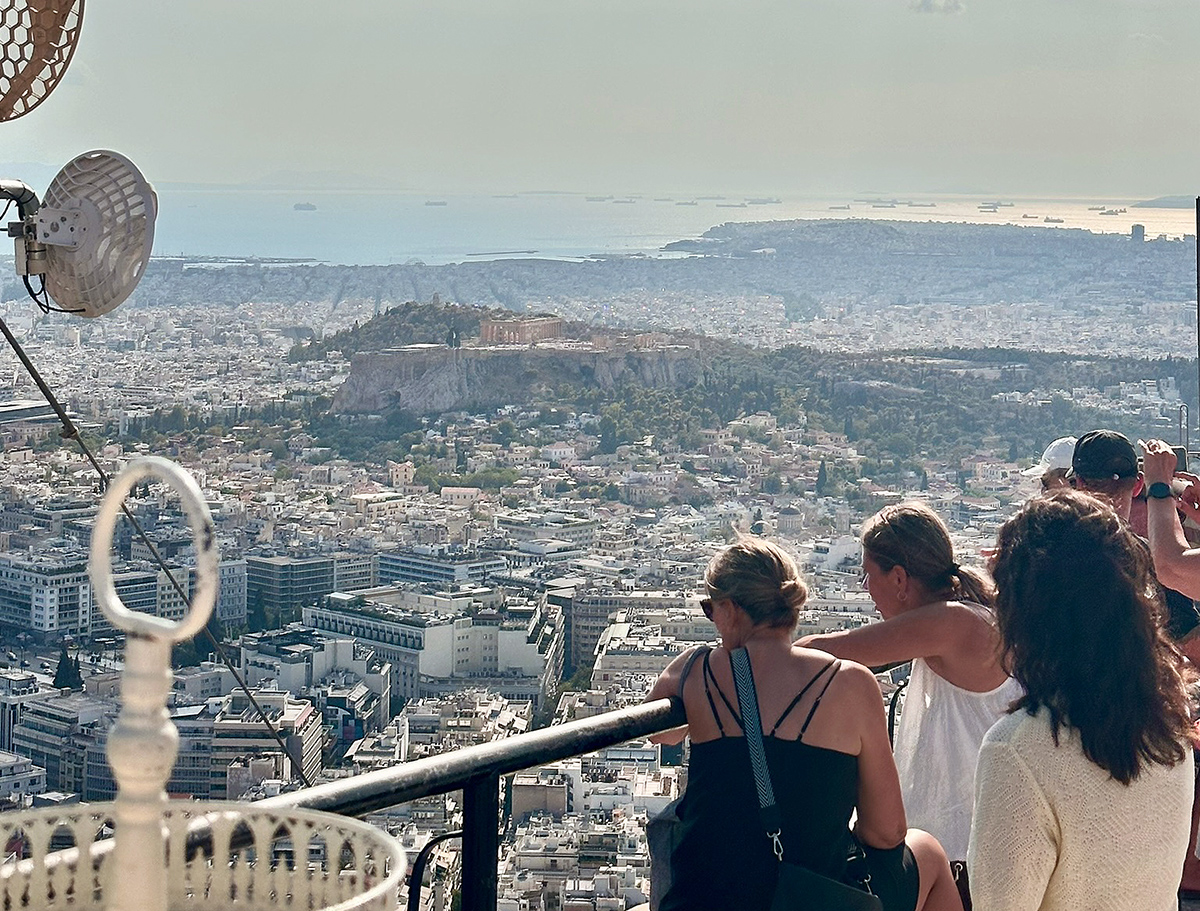
My initial curiosity about Athens was sparked by a New York Times travel story describing it as one of Europe’s most underrated capitals. I went in 2024 expecting antiquity: the Acropolis, archaeological sites, museums, and the familiar image of pale stone under the Mediterranean sun. What stayed with me after the trip was the contemporary city below the Acropolis.
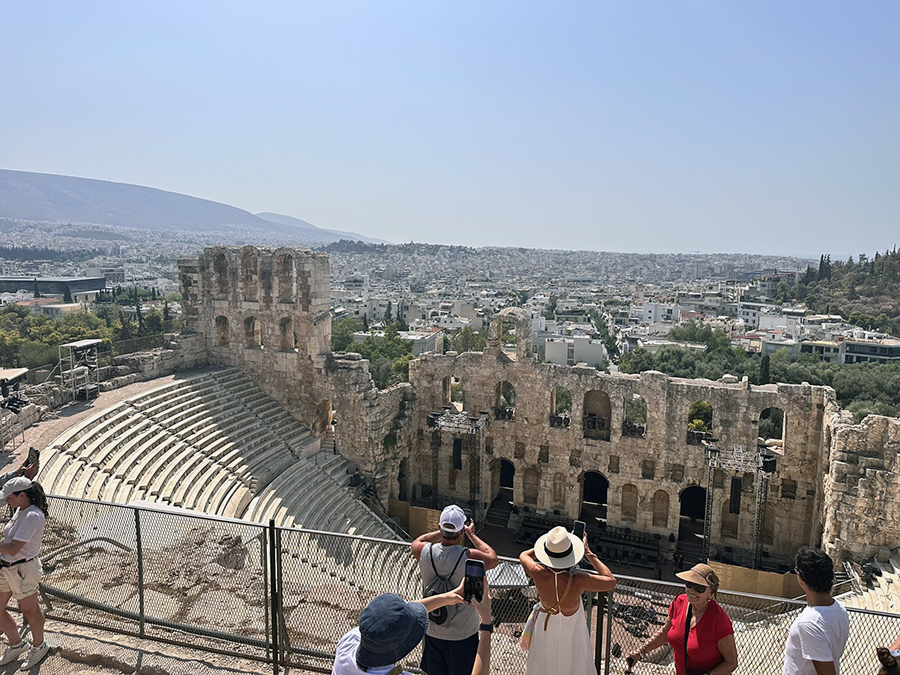
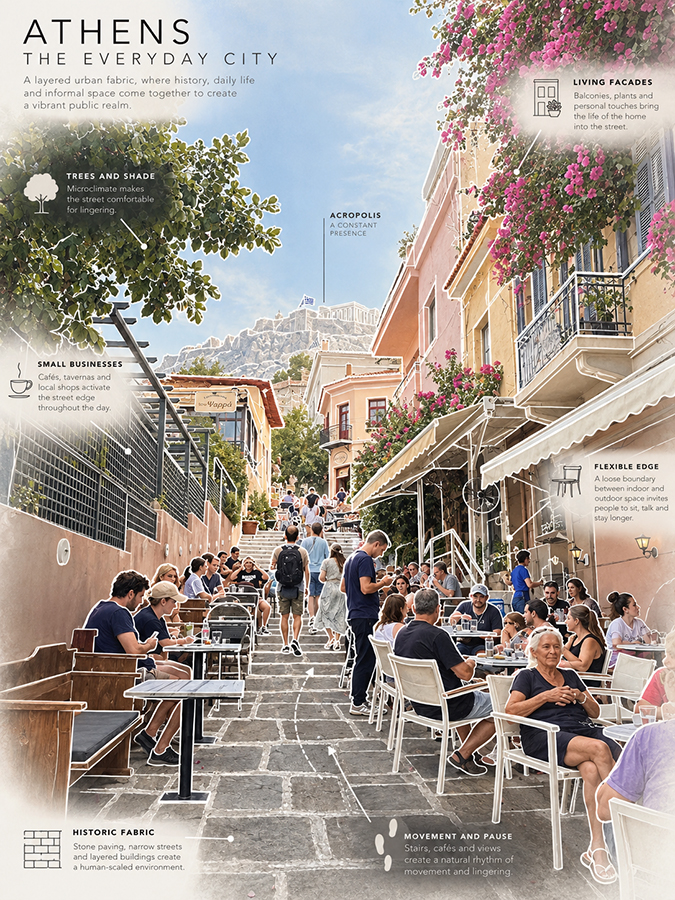
I remember crowded cafés extending into sidewalks, people talking on steps and street corners, small neighborhood squares, balconies hovering over narrow streets, trees and awnings creating pockets of shade, and ancient fragments appearing unexpectedly within the everyday city. None of these spaces seemed extraordinary on their own. Together, they created an unusual depth of public life.
As a landscape architect who has spent more than twenty years working across the United States and Asia, I found myself experiencing Athens through two lenses: as a traveler enjoying the city and as a designer quietly asking why these ordinary spaces felt so natural to inhabit.
Why does Athens feel so socially alive, even when much of its public realm does not appear formally designed to produce that effect?
A City Built Through Accumulation
Part of the answer lies in how modern Athens grew.
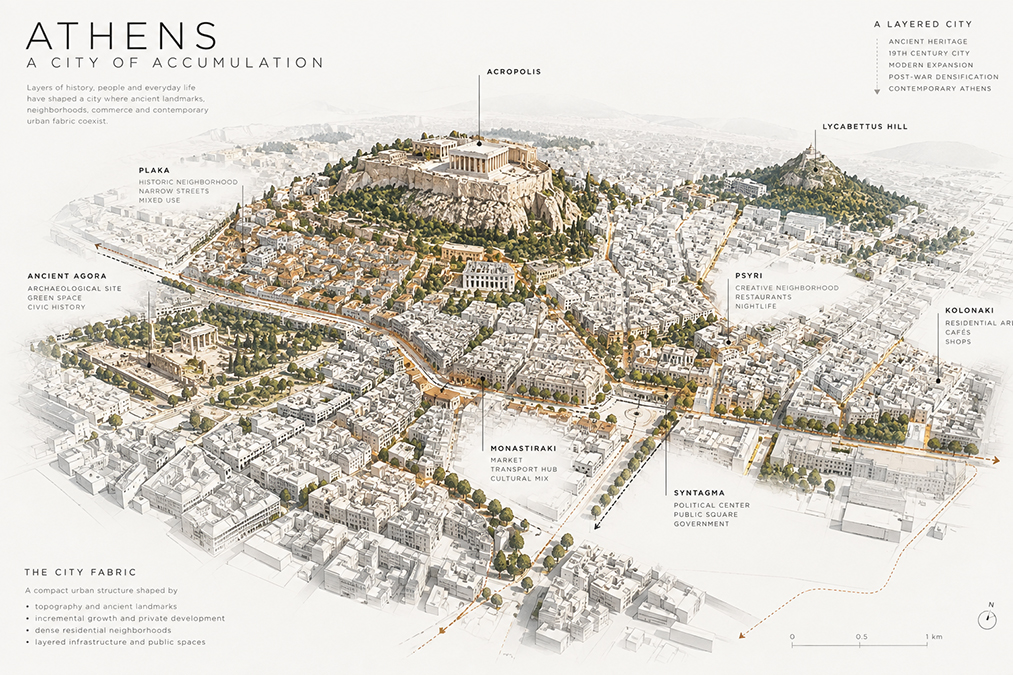
Athens was shaped by successive waves of population growth rather than by one coherent planning vision. The arrival of refugees from Asia Minor in the early twentieth century dramatically expanded the city. After World War II, migration from rural Greece brought another period of rapid urbanization. Later decades brought immigrants from the Balkans and elsewhere.
Housing had to respond quickly.
Much of the modern city emerged through relatively small-scale private development and the repeated construction of the polykatoikia, the multi-story apartment building that came to dominate Athens after the war. Dense residential blocks, shops and services at street level, balconies above, and narrow streets created a city where large numbers of people lived close to the activities of everyday life.
Athens was not composed as a finished urban image. Much of it accumulated.
For someone accustomed to contemporary master planning, this is an interesting reversal. We often begin with a vision, establish a framework, define uses and circulation, and then anticipate the life expected to occupy the plan.
Athens often feels as if life came first, followed by adaptation, construction, regulation, and then more adaptation. It made me wonder: what happens when urban life precedes urban design?
The Street as Social Space
Density alone does not produce public life, but it creates conditions for frequent encounters.
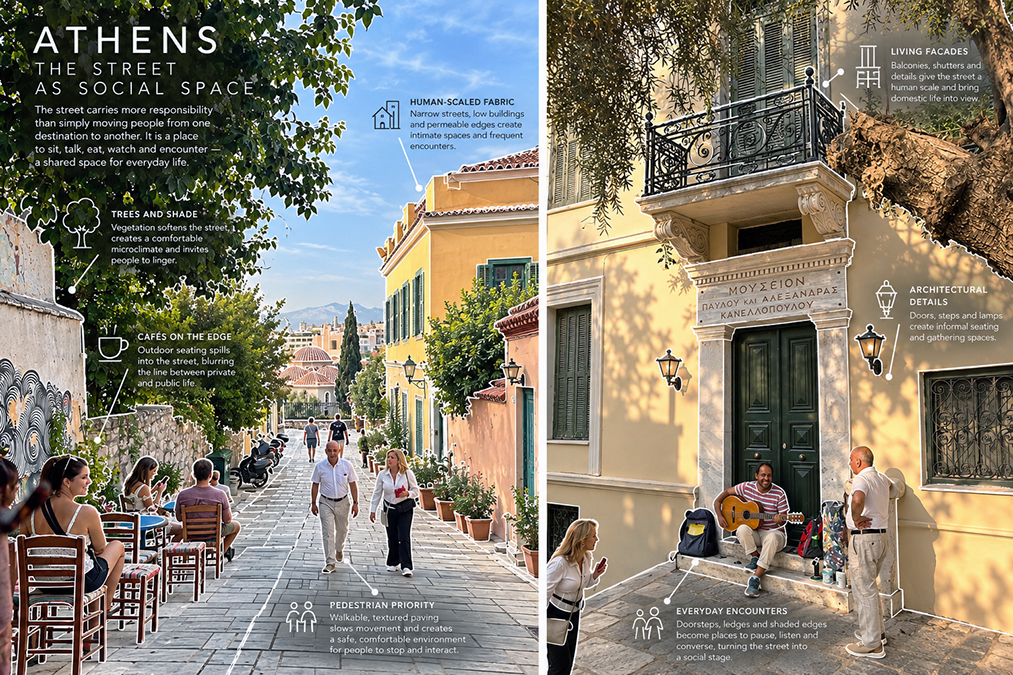
In Athens, residential life, commerce, food, transportation and social activity often sit close together. The street therefore carries more responsibility than simply moving people from one destination to another.
People stop. They talk. They eat. They wait. They watch other people.
This felt particularly interesting to me coming from Houston. Houston has many active destinations, but much of our public life requires going somewhere specific: a park, restaurant, shopping district or cultural destination. In Athens, public life often seems to happen on the way there. The distinction is subtle but important.
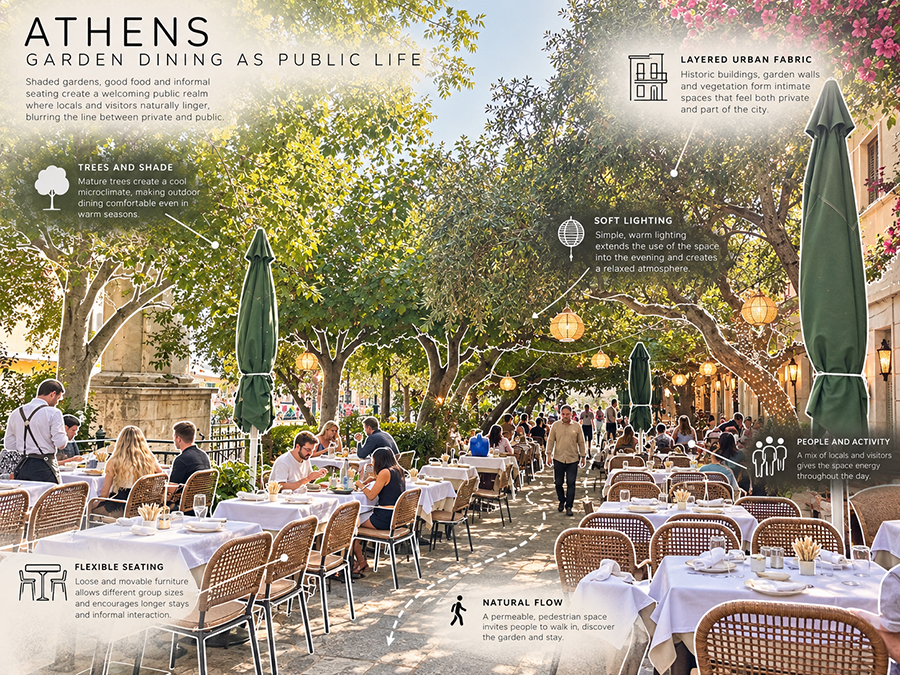
A café table on a sidewalk is commercial space, yet it also becomes part of the social life of the street. A building step becomes a seat. A patch of shade becomes a place to stop. A small square changes character as different people occupy it throughout the day.
The boundary between public and private feels less fixed.
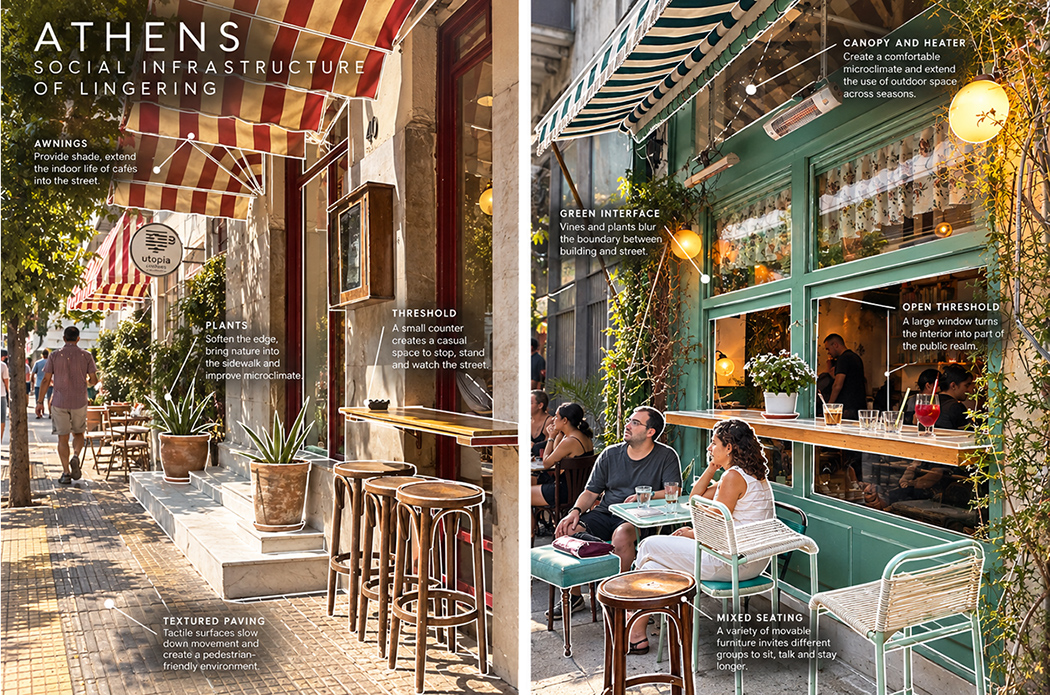
The Social Infrastructure of Lingering
Athens also made me think about something we rarely draw on a plan: permission to linger.
Cafés and tavernas play an obvious role. So do shade, balconies, awnings, trees, steps, edges and small leftover spaces. Together they form a social infrastructure made from many modest elements rather than a few monumental public spaces.
Climate matters. Shade is not decoration in a Mediterranean city. It influences where people walk, sit and gather. Architecture and landscape work together to create microclimates where public life becomes comfortable.
Culture matters too. The long traditions of outdoor eating, coffee, conversation and evening social life give people reasons to occupy these spaces for extended periods.
This raised a question for me as a designer.
We often design activity into public space. We locate seating, organize circulation, establish programs and define how different zones should operate. Athens suggests another measure of success: how much freedom do people have to make a space their own?
Perhaps public space needs some permission to remain unscripted.
The Productive Side of Imperfection
I would not romanticize Athens’ informality.
The same urban history that created density, mixture and adaptation also produced congestion, limited green space, uneven infrastructure and development patterns that contemporary Athens continues to address.
As a designer, though, I was interested in the other side of that imperfection: the capacity of people to continuously adjust the city around everyday life.
This is where Athens challenged some of my professional instincts.
Design practice teaches us to resolve things. We clarify circulation, coordinate edges, organize programs, select materials and anticipate operations. Much of this work is necessary. Well-designed public space improves accessibility, comfort, ecology and civic life.
Yet a completely resolved environment raises another question: have we left enough room for people to change it?
The lesson I took from Athens was not that informality is better than design. Nor was it that European public spaces are better than American or Asian ones. The more useful tension is between order and adaptability.
Looking from America and Asia
Working across the United States and Asia has exposed me to different models of public realm. American public spaces often operate within strong systems of regulation, accessibility, maintenance and management. Many newer Asian developments demonstrate extraordinary intensity, convenience, commercial integration and speed of delivery. I have spent much of my career working within these systems and value what thoughtful planning brings to cities.
Athens offered me a third condition. Its public life often feels accumulated rather than fully composed. Different periods remain visible. Buildings adapt. Uses overlap. People appropriate edges. The city feels less like a finished object and more like an environment continuously adjusted by those who inhabit it.
This makes Athens particularly interesting to me. Its urban richness does not come from one planning philosophy or one cultural tradition. History, migration, density, climate, commerce and social customs have accumulated over generations.
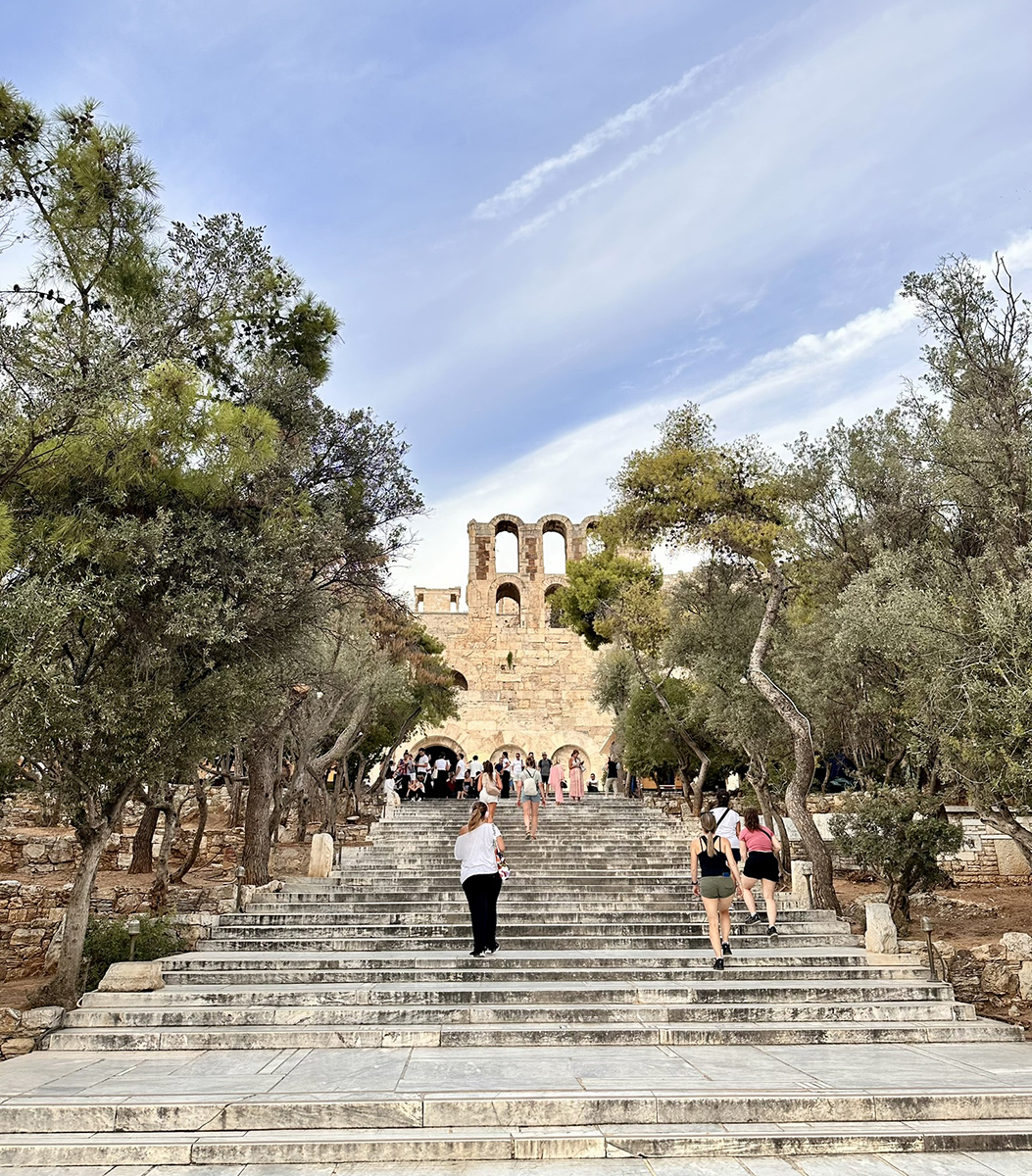
The Acropolis gave Athens its image. The streets below gave me my experience of the city.
I returned home with hundreds of photographs of ruins, buildings, cafés, streets and people. Yet the most useful thing I brought back was a question. How much of urban life should designers determine, and how much should we leave for people to determine themselves?
After more than twenty years designing public spaces in America and Asia, Athens reminded me that designers don’t create public life alone. We create conditions for it. People, culture and time complete the work.
Perhaps one of our responsibilities as designers is knowing when to leave enough room for them to do so.
All photos by Peiwen Yu