
 Suzhou is a city born of water. Millennia-old canals, gardens, and alleyways have shaped its skeleton and crystallized its understanding and expectations of public life. The Suzhou Huamao Center (China Trade Center) emerges from this very lineage – it does not merely stack modern functions but seeks a new balance between ancient urban traditions and contemporary lifestyle.
Throughout history, Suzhou’s waterway system has remained a central monument in the city’s landscape, framing the urban layout of this world-renowned garden city. These canals once served as the city’s lifeline, facilitating the transport of goods and fostering a dynamic urban space that nourished prosperity and wealth.
As a mega mixed-use development spanning approximately 9.5 hectares, the Suzhou Huamao Center (Gusu Li) is situated on the banks of the Shangtang River, adjacent to multiple UNESCO World Heritage sites. With an investment of approximately $1.27 billion, it integrates Suzhou Mixc World Retail, The Ritz-Carlton Hotel, H+ Art Museum, Grade-A office towers, and residential clusters, aspiring to become a new-generation cultural and lifestyle destination within the ancient city, reinjecting contemporary vitality into this historic metropolis.

Land use composition of Suzhou Huamao Center
The project’s urban design was a collaboration between SWA and architecture teams including KPF and OVAL. The design began within a highly sensitive urban context: on one side, the continuous fabric of the ancient city; on the other, the pressing need for renewal. Through multiple rounds of discussion, a consensus emerged: the project’s true challenge was not merely scale or image, but how, amidst rapid urban development, to preserve rhythm and warmth for public life, allowing people to “slow down” in their daily routines.
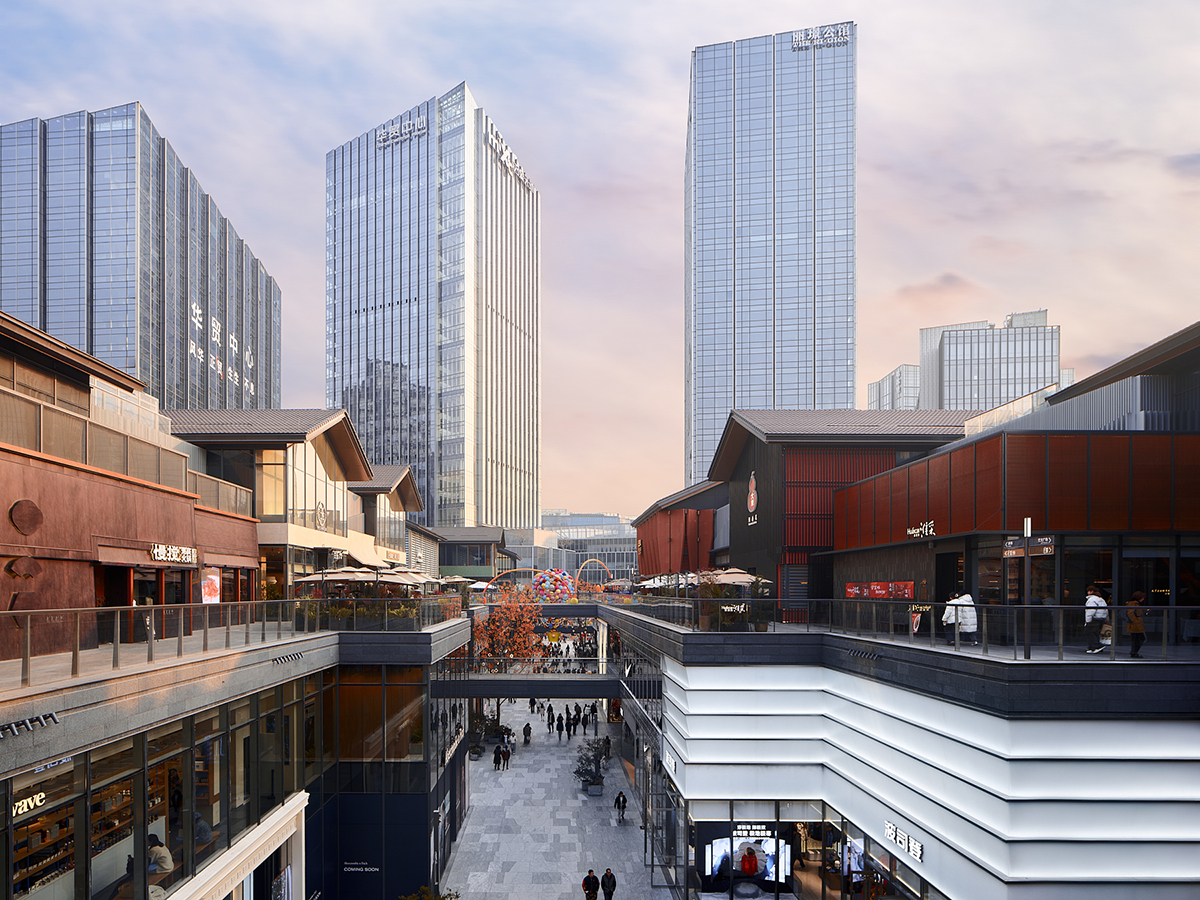
Architectural Form Continuing the Ancient City Texture
The site is located on the banks of the Shangtang River at the edge of Suzhou’s ancient city, where water lanes and streets intertwine, sustaining a lively urban lifestyle. The team returned to the origins of the ancient city, examining its spatial structure, daily activities, and the authentic role of “water.” Historically, water in Suzhou was not mere ornamentation but the bedrock of organized life; waterfronts were markets, docks, places for people to linger and converse. Thus, the design proposes a spatial narrative of “FAST CITY, SLOW WATER”—juxtaposing high-density modern functions with public spaces for daily life. Utilizing pedestrian systems featuring water scenes, streets, and bridge corridors, the design moderates the urban pace, allowing “fast” and “slow” to coexist within the same place.

Design Narrative: Fast City & Slow Water
In its overall spatial structure, the project breaks away from enclosed complex models, organically organizing different functions through open pedestrian streets, plazas, and waterfront spaces. The water system becomes the main spatial thread, with public activities unfolding along it, and pedestrian paths guided towards more intimate, linger-worthy scales. The design does not seek overwhelming vistas at a glance but emphasizes an experience that gradually reveals itself through movement. Traditional Suzhou living symbols, such as boats, lanterns, and garden elements, are translated into landscape language, woven throughout streets and open spaces, evoking memories of waterside life through a contemporary visual vocabulary.

Spatial Translation: From Traditional to Contemporary
SWA and OVAL conducted in-depth discussions on activating the retail street network, with the design logic centered on how curated points of interest shape pedestrian movement. Engaging moments are placed along the streets to guide foot traffic and energize the site. Rather than relying on a single focal node, a sequence of connected moments structures the spatial experience, encouraging discovery, pause, and continued movement through the district. Art installations, outdoor seating, canopy trees, bridges, and arcades integrate into the street framework to form a layered, interactive sequence that supports everyday exploration and strolling. Paving design reinforces this experience through subtle transitions in materials and textures, enriching both visual and tactile perception along the retail streets.

Landscape Overall Plan
For the public space language, the team did not replicate historical forms but extracted perceptible contemporary cues from Suzhou’s culture. The paving in plazas and pedestrian areas draws inspiration from the grayscale rhythms of Chinese ink-wash painting, using layers of black, gray, and white to interpret water flow, ripples, and rhythm. This is not merely a pattern; it integrates traditional aesthetics into the ground plane, becoming part of the spatial narrative. Walking through, textures unfold with each step, as if entering a gradually flowing scroll painting.

Paving inspiration: ink smudge technique

Ink-Wash Paving: A Painting Unfolding Underfoot
The North Art Plaza, inspired by the traditional waterfront pier, redefines the spatial dialogue between the city and the water’s edge by introducing a vast expanse of calm water. More than just a symbolic gateway to the district, it transforms into an “urban vessel” embracing diverse public life. Here, the lively chatter of markets, festive gatherings, casual pauses by strollers, and waterside art performances naturally converge. The reflections on the water extend the spatial dimension, allowing the plaza to grow—between reality and illusion—into an open, fluid, and vibrant stage for everyday life along the water.

North Art Square: Wharf
The design of the Central Square draws inspiration from the spatial layout of the traditional Chinese “theater stage.” By evoking the performer-audience relationship between the stage and the viewing stands, the square naturally forms an urban gathering space through guided pathways and controlled spatial boundaries. Here, people are not mere spectators but active participants, allowing public life to emerge organically. The square also serves as a natural venue for seasonal merchant activities, diverse pop-up projects, and public art installations. Furthermore, design strategies such as temporary road closures and extending pavement materials from the square onto adjacent streets have been incorporated to enhance the space’s cohesion and capacity for hosting events.

Central Square: Stage and Gathering Space
Water assumes different states across scenes: still water reflects architecture and sky, reinforcing order; dynamic water, through flow and fountain jets, activates plazas and moderates microclimates. Water transforms from a visual backdrop into a vital medium connecting spaces and guiding behavior.

Design node: The Multifaceted Expression of Water
In detailed design, the team transformed the “boat”—a traditional image deeply embedded in Suzhou’s memory—into simple, contemporary landscape elements. Boat-shaped seating and planters are scattered throughout nodal spaces, providing rest and viewing functions while carrying the narrative of waterside life. These elements are not literal symbolic copies but are integrated into people’s pauses and passage through subtle modern language, naturally evoking cultural perception during everyday use.

Boat-Shaped Furniture & Nodal Space Design
In relatively tranquil areas such as the Ritz-Carlton hotel entrance and secondary courtyards, the landscape design shifts towards a more introverted garden expression. At the center of the hotel drop-off plaza, an approximately 150-year-old ginkgo tree was preserved intact, becoming the spiritual anchor governing the space. The design organizes circulation and pause points around the ancient tree, guiding visual progression layer by layer, echoing the traditional bonsai wisdom of “seeing the large within the small.”

Hotel Entry: Contemporary Experience of Traditional Gardens & Local Culture

Tree planter design for protecting century-old ginkgo trees
A black reflective pool and a liquid stone sculpture placed to one side together form a “modern bonsai”: the water surface mirrors sky and tree shadows, while the sculpture stands in silence. Acting as a scenic wall and foreground interface, they clearly demarcate interior and exterior spaces. Scale is restrained here, plantings are disciplined, and through the combination of water, stone, and negative space, a tranquil yet tension-filled arrival experience is created. This forms a vivid contrast with the active rhythm of surrounding commercial spaces, allowing the entry sequence to reveal a deeply rooted regional cultural character within its order.


A modern bonsai created by a black mirrored pool
The hotel’s landscape design further extends and deepens the thematic language of the interior spaces, interpreting the refinement of a bonsai garden and the elegance of nature with contemporary strokes. The rooftop landscape terrace gracefully extends the leisure experience outdoors, where Suzhou’s timeless garden tradition subtly merges with fashionable modern aesthetics. By creating seamless indoor-outdoor connections, the design not only fosters a relaxing sanctuary atmosphere but also allows the architecture to gently integrate into the city’s overall landscape tapestry, forming a harmonious and cohesive experience.


Seamless Indoor-Outdoor Bonsai Garden
The design team drew inspiration from the Qing Dynasty masterpiece “Gusu Prosperity Painting,” translating its continuous riverside scenes of bustling life into a sequence of spaces meant for strolling and lingering. The palpable sense of lived life flowing through the ancient painting becomes the underlying tone of the contemporary spatial experience—space is not perceived instantly but is gradually “read” through movement, forming coherent and rich layers.
This urban design framework crystallized through multiple rounds of deliberation and collaboration. SWA and the architecture teams consistently sought balance between cultural memory and contemporary reality. The final outcome is neither nostalgic revival nor a modern gesture divorced from context, but rather an urban condition situated between fast and slow.

Left: Outer Street (designed by SWA) Right: Inner Lane (designed by Lab D+H)

Suzhou Huamao Center on the banks of the Shangtang River
Commerce, offices, and hotels operate efficiently; people remain busy. Yet, by the water’s edge, in plazas and along alleyways, the city’s rhythm is gently modulated, and public space once again becomes part of daily life. For a continuously renewing ancient city, this design approach—achieved through spatial organization rather than slogans, through authentic use rather than mere symbols—is itself a form of continuity.
Project Information
Project Name: Suzhou Huamao Center
Client: Huamao Group
Suzhou MixC World Retail Developer: China Resources Land
The Management of Ritz-Carlton Hotel: Marriott Group
Site Area: 95,000 sqm
SWA Services: Landscape Concept Planning & Schematic Design, The Ritz-Carlton Hotel Schematic Design and Construction Site Coordination
Schedule: 2018-2024
Architecture Design: KPF, OVAL
Suzhou MixC World Retail Landscape Design: Lab D+H
Construction Documents: Suzhou Hezhan Design & Construction Co., Ltd
Photography: DO Studio, Chillshine